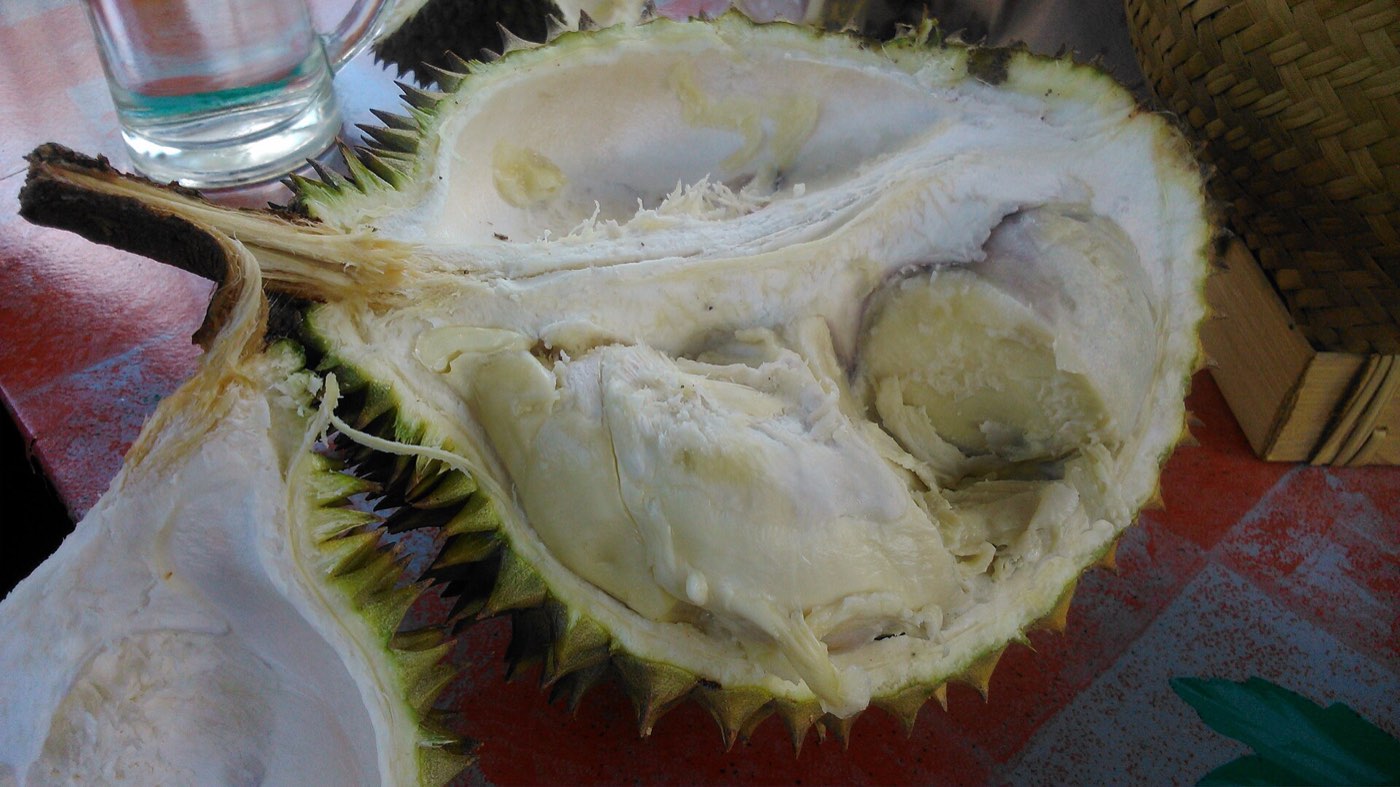
Durian:
worth it, once, in season
The fruit deserves better than the clichés attached to it. Eaten fresh, in season, from a stall that knows what it is selling, durian is one of the genuinely singular things you can put in your mouth — and it is nothing like the frozen supermarket version most people have met.
Do it, and do it properly. Season is roughly June–August, with a smaller, less reliable window in November–December; outside those the fruit is frozen, imported or last year’s. Go with someone who can pick — a stall-holder, a guide, a Malaysian friend — because the difference between a good fruit and a bad one at the same price is enormous and you cannot yet tell. The only pricing we could verify is buffets at RM49.90–148 a head, so that is the only pricing on this page: per-kilo Musang King prices could not be confirmed and we deliberately do not publish one. Two practical constraints. Almost every hotel and all public transport prohibit it, and this is real and enforced. And eat it where you buy it — that is the custom, and it solves the first problem.
Without the tired comparisons
Durian does not taste like onions, gym socks or anything else the internet has told you. It tastes like a very ripe, heavily perfumed custard — and the specific quality worth preparing for is not the flavour but the texture.
The flesh sits in segments around large seeds and comes away in thick, soft lobes, somewhere between a set custard and a ripe avocado, and warm from having been in the sun. The flavour is sweet and rich with a savoury undertow that is closer to a good aged cheese than to fruit — caramel, vanilla, a little garlic, a little alcohol at the finish on the better varieties. The smell arrives before the taste and is much stronger than the taste, which is the whole basis of durian’s reputation. People who dislike it almost always dislike the smell and the density, not the flavour.
Variety matters more here than with any other fruit. Musang King is the benchmark — deep yellow, bittersweet, custardy, the one everything else is measured against. D24 is the older workhorse, milder and creamier, and it is the one to start on if you are nervous. Black Thorn is the current prestige variety, softer and sweeter with a smaller seed. Red Prawn (Udang Merah) is orange-fleshed, sweeter and less bitter, and it is the easiest of the four for a first-timer to like.
The critical distinction: fresh against frozen. Almost all durian eaten outside Malaysia is frozen, and freezing changes the texture into something wetter and flatter while dulling the aromatics. A fresh fruit opened in front of you in Kuala Lumpur in July is a different food from the one in a Chinatown freezer in London, and it is the reason this is worth doing here rather than at home.
How to eat it: with your hands, standing up, at the stall. The seller will open the husk with a blade and gloves, you take a lobe, you eat around the seed, and you use the water and wet wipes they hand you afterwards. The custom is to eat it where you buy it, which is not just tradition — see the ban section below.
Musang King, D24, Black Thorn and Red Prawn
Which to ask for and in what order. Try two side by side if you can — the differences are much larger than the descriptions suggest, and a single fruit tells you very little about the species.
| Variety | What it is like | Who it suits | Verdict |
|---|---|---|---|
| Musang King Mao Shan Wang | The benchmark. Deep yellow, dense, bittersweet, with a long alcoholic finish. The most prestigious and the most exported | The one to have if you are only having one. Also the strongest, so not the gentlest introduction | WORTH IT |
| D24 | The older workhorse variety. Milder, creamier, less bitter, more straightforwardly sweet | The right starting point if you are unsure. Cheaper than Musang King and much easier to like on the first mouthful | WORTH IT |
| Black Thorn Ochee | The current prestige variety. Very soft, sweeter than Musang King, smaller seed so more flesh per fruit | Anyone who liked Musang King and wants the other end of the top shelf. Scarce, and priced accordingly | DEPENDS |
| Red Prawn Udang Merah | Orange-tinged flesh, sweet, wet, notably less bitter than the others | The easiest of the four to enjoy cold-start. A good second fruit to put beside a Musang King for contrast | WORTH IT |
On price, we are deliberately silent. Per-kilo rates for Musang King move week to week with the harvest and vary wildly between stalls, and we could not verify a figure we would stand behind — so we do not publish one. The only durian pricing we could confirm is the buffet band below. Ask two stalls before buying, and agree the price per kilo and the weight before the fruit is opened.
The durian calendar
Durian has a main season and a minor one, and outside them the fruit on sale is frozen, imported or held in cold storage. If your trip does not overlap either window, skip it and eat something else — the dish list has ten better uses of the meal.
Peak is roughly June–August, with a smaller and less dependable window in November–December. The seasons shift by a few weeks year to year with the weather, so check before you build a trip around it. Best time to visit covers how this lands against the rest of the calendar.
Where you cannot take it, which is almost everywhere
This is not a quirky travel-blog anecdote. The prohibitions are posted, they are enforced, and being turned back at a hotel lift holding an open durian is a genuinely common way for this to go wrong.
Almost every hotel in Kuala Lumpur prohibits durian in the rooms and often in the building, and this one is enforced — the smell persists in soft furnishings for days and cleaning it is a real cost. Some properties charge a cleaning fee. Do not test it, and do not assume a sealed box solves it, because it does not.
MRT, LRT, monorail, KTM Komuter and the KLIA Ekspres all ban durian, with signage at the gates. Grab drivers will usually refuse it too, and are entitled to. Plan on eating it where you buy it — which happens to be the correct way to eat it anyway.
Signed at every station gateAirlines prohibit durian in both cabin and hold, so buying a fruit to take home is not an option. Vacuum-packed and frozen products sold in airport shops are a different category and are permitted — check the packaging states it is sealed for air travel before you buy.
The seller opens it, hands you the lobes and provides water and wipes. This is the custom, it is the best way to eat it — warm, minutes after opening — and it solves every problem above at once. Expect to spend fifteen minutes and to need both hands.
Malaysians will tell you not to, and it is worth respecting whatever you make of the physiology. Given what alcohol costs here — RM22–35 a pint — it is an easy rule to follow. Water or a soft drink with it, and leave the bar for another night.
It is extremely rich — fatty, sugary and dense — and a serious quantity late at night sits heavily. Eat it in the afternoon or early evening rather than as supper, and eat less than you think you want on the first attempt.
Durian, practically
SS2, Bukit Bintang, and the buffet question
Two places most visitors end up, and one format worth understanding before you commit to it.
SS2, Petaling Jaya is the durian street — a run of stalls that has been the Klang Valley’s default for decades, busiest in the evening during the season, and staffed by people who will happily talk you through four varieties. It is a Grab ride of roughly 20–30 minutes out of the centre and it is where to go if you want the real version of this. Ask for two varieties side by side; every stall expects it.
Bukit Bintang’s durian stalls are the convenient option — walkable from most visitor hotels, open late, and priced accordingly. The fruit can be perfectly good; you are paying a location premium and dealing with sellers whose customers are mostly one-time buyers. If your trip is short, this is a reasonable trade. If you have an evening, go to SS2.
The buffet format is the one thing here we can price with confidence: RM49.90–148 a head for all you can eat, usually including several varieties and often a farm visit or a transfer. It is a good structure for a first encounter — you get to compare varieties without buying four whole fruits, and someone is picking for you. It is a poor structure if you only want two lobes of Musang King, and a bad idea in March, when everything on the table came out of a freezer.
Whichever you choose, agree the price per kilo and the weight before the fruit is opened. That is the one place this transaction goes wrong for visitors, and it is entirely avoidable — the same principle covered on the scams page.
The guided version, for a first time
The argument for booking is picking. Variety, ripeness and value are three judgements you cannot make on your first fruit, and a farm experience puts all three in someone else’s hands while you concentrate on eating.
Durian in Kuala Lumpur FAQ
Is durian banned in hotels?
In practice, yes — almost every hotel in Kuala Lumpur prohibits it in rooms and often in the building, and some charge a cleaning fee. The smell persists in soft furnishings for days. It is also banned on the MRT, LRT, monorail, KTM Komuter and KLIA Ekspres, with signage at the gates, and on aircraft in both cabin and hold.
What does durian taste like?
A very ripe, heavily perfumed custard — sweet and rich with a savoury undertow closer to aged cheese than to fruit, with caramel, vanilla and a slight alcoholic finish on the better varieties. The smell is much stronger than the taste, and the texture, somewhere between set custard and ripe avocado, surprises people more than the flavour does.
When is durian season in Malaysia?
Roughly June to August for the main season, with a smaller and less dependable window in November and December. Outside those months the fruit on sale is frozen, imported or from cold storage, and it is a genuinely different food — if your trip misses both windows, spend the meal elsewhere.
How much does durian cost in Kuala Lumpur?
The only pricing we could verify is the buffet format, at RM49.90–148 a head for all you can eat. Per-kilo rates for Musang King move week to week with the harvest and vary widely between stalls, so we deliberately do not publish a figure. Agree the price per kilo and the weight before the fruit is opened.
Which durian should I try first?
D24 or Red Prawn if you are unsure — both are milder, sweeter and less bitter than the benchmark. Musang King is the one everything is measured against and the strongest of the four, so it is the best single fruit and not the gentlest introduction. Black Thorn is the current prestige variety and is priced for it.
Where can I buy durian in Kuala Lumpur?
SS2 in Petaling Jaya is the classic stall street, about 20–30 minutes by Grab from the centre and busiest in the evening during the season. Bukit Bintang has durian stalls that are far more convenient and correspondingly more expensive. Eat it at the stall — that is the custom, and everywhere else has banned it.
Is durian safe to eat with alcohol?
Malaysians will firmly tell you not to combine them, and it is worth respecting. It is easy advice to follow here anyway: a pint is RM22–35 in Kuala Lumpur, so leave the drinking for a different evening and have water with the fruit.
Is durian worth trying if I hate the smell?
Try one lobe of Red Prawn or D24 at a stall rather than committing to a buffet. The smell is much stronger than the taste, and a lot of people who react badly to a durian-scented corridor are perfectly happy with the fruit itself. If the first mouthful settles it, you have lost RM20 and fifteen minutes.