Kampung Baru:
a village under
the Twin Towers.
Nine hundred acres of Malay village — wooden houses on stilts, kampung lanes, a mosque, a Saturday market — sitting directly under the Petronas Twin Towers, about fifteen minutes on foot from the most expensive real estate in Malaysia. It exists because of a 1900 land grant that reserved it for Malay settlement, and it survives because its several thousand fragmented land titles have defeated every redevelopment scheme aimed at it for forty years. That threat is permanent and the outcome is not settled. Go for the contrast, go for the Saloma Link bridge at night, and above all go for Nasi Lemak Wanjo, 8 Jalan Raja Muda Musa, 06:00–24:00, RM10–15 — the best nasi lemak in Kuala Lumpur. Then sleep in Bukit Bintang or KLCC: this is a residential neighbourhood, not a hotel district.
The most improbable 900 acres in Southeast Asia
Kampung Baru is a working Malay village with a skyline behind it, and the reason it still exists is a property-law deadlock rather than a preservation order. Understand that and the whole place reads differently.
The land was set aside as a Malay agricultural settlement in 1900, when this was open ground outside a tin-mining town. The city then grew around it and past it, and by the 1990s the Twin Towers were going up 1.5km away. What stopped the bulldozers was not sentiment: the land is held under a reservation with thousands of fragmented, inherited titles, and assembling them has defeated every scheme for four decades. Valuations in the billions of ringgit have been floated, rejected and floated again. The threat is permanent, the timeline is unknowable, and every year a few more of the wooden houses come down anyway.
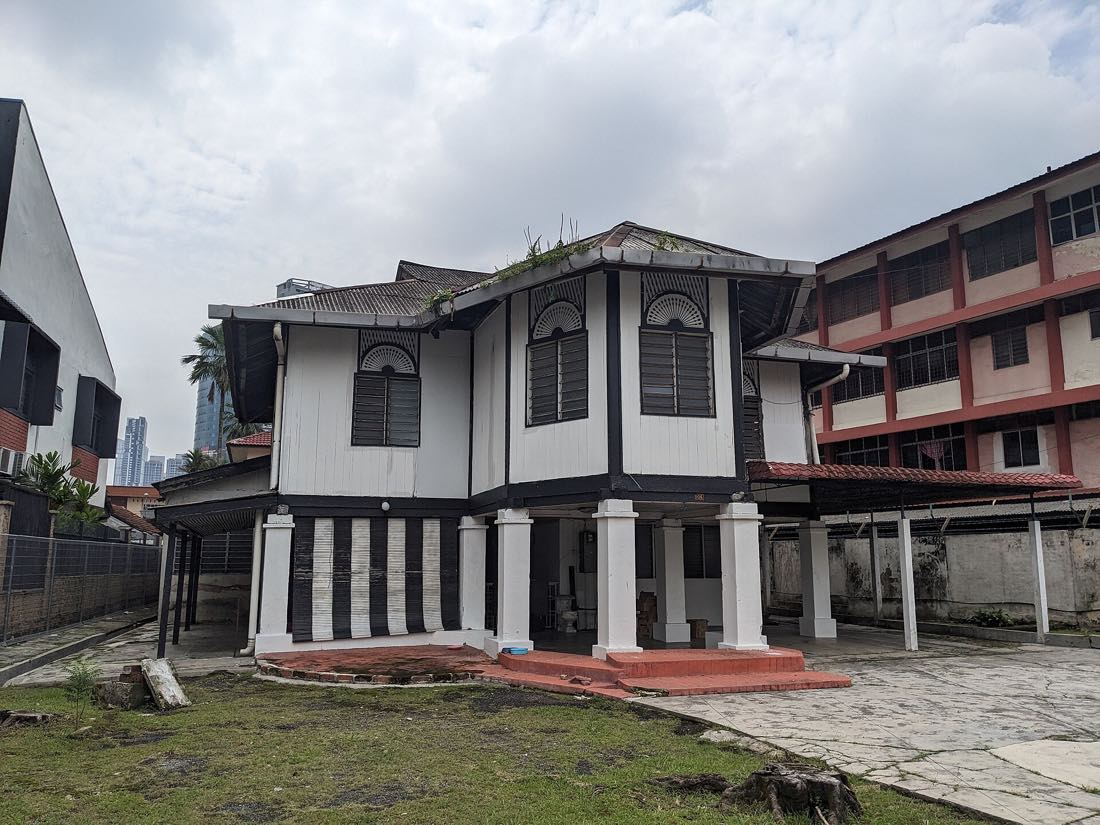
What you actually walk through is a low-rise grid of timber houses on stilts with tiled verandas and fruit trees, warungs with four tables, a school, a police station and the Jamek Kampung Baru mosque, with the towers standing over the roofline at the end of almost every street. The contrast does not need explaining and it does not photograph as well as it looks, which is part of the point.
The Saturday market is the busiest the neighbourhood gets — a night market that sets up along the main streets on Saturday evening and runs into the small hours, selling food far more than souvenirs. It is the one time this village turns outward. On any other day the appeal is the ordinariness: a residential neighbourhood at 09:00 on a Tuesday, doing nothing for your benefit.
The connection to KLCC is the Saloma Link, a pedestrian bridge over the Klang river shaped like a sirih leaf and lit at night in changing colours. It is free, it takes about four minutes to cross, and it is the best free night photograph in Kuala Lumpur — the towers framed through the bridge’s lattice with the village on the near side. Walk it after the 20:30 fountain show at KLCC Park and you have the two best free things in the city in one evening.
Kampung Baru, decided
Small area, short list, and one entry that is the reason most people come. Everything here is free except the food, and the food is under RM20.
| What | Verdict | When | Cost | The detail |
|---|---|---|---|---|
| Nasi Lemak Wanjo | WORTH IT | 06:00–24:00 | RM10–15 | 8 Jalan Raja Muda Musa. The best nasi lemak in Kuala Lumpur — coconut rice, sambal, anchovies, egg, with rendang or fried chicken added over the counter. Breakfast is the right meal but it runs to midnight, which makes it the best late plate near KLCC. |
| Saloma Link bridge | WORTH IT | After dark | Free | A sirih-leaf pedestrian bridge over the river connecting the village to KLCC. Four minutes to cross, lit in changing colours, and the best free night photograph in the city. Pair it with the 20:30 fountain show. |
| The Saturday night market | WORTH IT | Saturday evening onward | Food from RM5 | The one night the neighbourhood turns outward. Food-led rather than souvenir-led, which is exactly why it is worth timing your week around if you can. |
| Walking the kampung lanes | WORTH IT | Before 10:00 or after 17:00 | Free | Timber houses on stilts, verandas, fruit trees and the towers over the roofline. Thirty to forty minutes covers it. Midday is 32°C with no shade and no reason. |
| Jamek Kampung Baru mosque | DEPENDS | Outside prayer times | Free | A working neighbourhood mosque rather than a monument — visit respectfully or admire it from the street. If you want the architectural experience, Masjid Negara is the one built for visitors, with robes provided. |
| Sleeping here | SKIP | — | — | There is essentially no hotel stock and no reason to want any. It is fifteen minutes on foot from KLCC and ten from the monorail — visit, eat, cross the bridge, and sleep somewhere with a room. |
Kampung Baru is served by LRT Kelana Jaya line at Kampung Baru station and by the monorail at Medan Tuanku on the western side. From KLCC, walking over the Saloma Link is faster than either.
This is somebody’s street, not an attraction
Kampung Baru gets a steady trickle of visitors and almost no infrastructure for them. Four things make the difference between being a guest and being a nuisance.
Shoulders and knees covered for everyone. This is a conservative Malay neighbourhood with a working mosque at its centre, not a tourist quarter with a dress code sign. Beachwear reads exactly as badly here as it would in a suburb at home.
The wooden houses are private homes and people live their lives on the verandas. A gesture at the camera and a nod is enough, and it is almost always granted. Photographing through a doorway without asking is the one thing that reliably causes offence.
The lanes are residential and narrow, and sound carries. The market on a Saturday is the exception — that is a public event and the whole neighbourhood is in it.
Kampung Baru is a Malay-Muslim neighbourhood and drinking in public here is a straightforward mistake rather than a legal one. Syariah law binds Muslims only and never applies to tourists, but that is not the point — the point is that this is a residential village and you would not do it in one at home. The bars are ten minutes away in Bukit Bintang.
Kampung Baru, practically
Bases within walking distance of Kampung Baru
Nobody stays in Kampung Baru and you should not try. These are the two areas that put you within a fifteen-minute walk of the nasi lemak, both with actual hotel stock.
Kampung Baru FAQ
Is Kampung Baru worth visiting?
Yes, for about two hours. It is 900 acres of Malay village with wooden stilt houses sitting directly under the Petronas Twin Towers, and there is nothing else like that juxtaposition in Southeast Asia. Go early or late for the light and the heat, eat at Nasi Lemak Wanjo, and cross the Saloma Link after dark.
Where is the best nasi lemak in Kuala Lumpur?
Nasi Lemak Wanjo at 8 Jalan Raja Muda Musa in Kampung Baru, open 06:00 to 24:00, RM10–15 a plate. It is one of the ten dishes worth planning a day around in this city. Note that the more famous Nasi Lemak Antarabangsa nearby rates 3.1/5 and ranks #1,553 of 4,942 restaurants — it is coasting on a 1980s reputation.
Can I walk from KLCC to Kampung Baru?
Yes, over the Saloma Link bridge — a lit pedestrian crossing over the Klang river shaped like a sirih leaf. It takes about four minutes to cross and roughly fifteen minutes door to door from Suria KLCC to the village. It is free and it is the best night photograph in the city.
Is Kampung Baru being demolished?
It is under permanent redevelopment pressure and has been for forty years. The land is held under a 1900 Malay settlement reservation with thousands of fragmented inherited titles, which has defeated every acquisition scheme so far. Individual houses do come down. Nobody can tell you a timeline for the whole village.
What should I wear in Kampung Baru?
Shoulders and knees covered. This is a conservative Malay residential neighbourhood with a working mosque at its centre, not a tourist quarter — the same clothes you would wear to visit Masjid Negara are right here, and nobody will hand you a robe because nobody is running it as an attraction.
When is the Kampung Baru market?
The main market runs on Saturday evening into the night along the neighbourhood’s main streets, and it is food-led rather than souvenir-led. That is the one evening the village turns outward, and it is worth arranging your week around if the timing works.
Should I stay in Kampung Baru?
No. There is almost no hotel stock and no reason to want any. Stay in KLCC, Chow Kit or Bukit Bintang and walk in — see the full area comparison for the trade-offs between them.
Related tickets, tours and stays
Deep links to specific products for the places on this page. Prices and availability are shown by each provider.