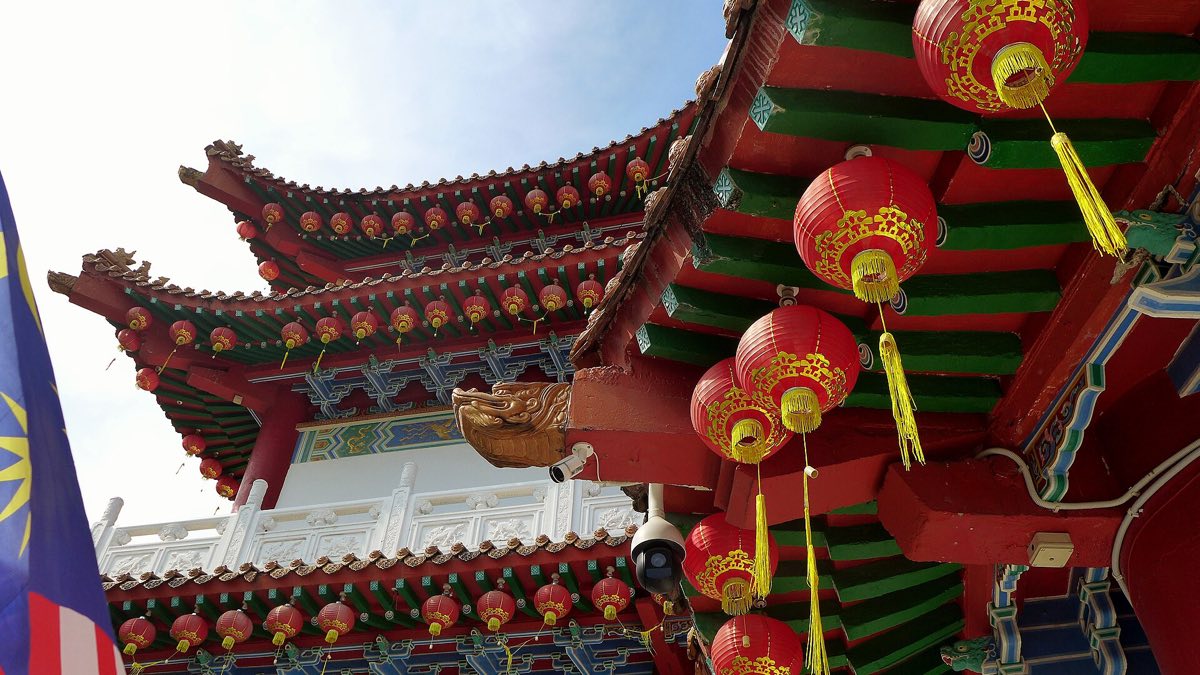
Thean Hou Temple:
free, and the best view in KL.
A six-tiered Chinese temple on a hill above Seputeh, with the Kuala Lumpur skyline behind it and no ticket office anywhere. It is the best free combination of architecture and view in the city, and the opening hours you have read online are probably wrong.
It is free, it opens 09:00–18:00, and it gives you something no paid viewpoint in Kuala Lumpur can: a skyline with a foreground. From the upper terrace the Twin Towers and Merdeka 118 sit behind two hundred red lanterns and a set of dragon-columned balustrades, which is the difference between a photograph of a city and a photograph of this city. Correct the hours before you plan around them: a great many sources publish 08:00–20:00 for Thean Hou and they are wrong — it is 09:00 to 18:00. Go at opening, when the light is on the eastern face and the terraces are empty. The one genuine friction is getting here: it is on a hill in Seputeh, awkward by rail, and a Grab is the honest answer.
What is at Thean Hou, and what it is for
A working temple rather than a monument, six tiers up a hillside, dedicated to Mazu — the sea goddess of Chinese coastal communities — and run by the Hainanese association of Kuala Lumpur. Entry costs nothing and nobody will approach you for money at any point.
The building was completed in 1987, which makes it modern by temple standards and is exactly why it looks the way it does: it is a deliberate, confident, full-scale piece of Chinese temple architecture built with twentieth-century money and no compromises. Sweeping tiled roofs, dragon columns, a grand double staircase, and the tiers stacked up the slope so that each level looks out further than the one below.
It is syncretic, and that is the interesting part rather than a footnote. The main hall holds three deities — Mazu the sea goddess, Guanyin and Shuiwei Shengniang — with Buddhist, Taoist and Confucian elements sharing the same building without friction. Downstairs there is a hall of Chinese medicinal herbs and a set of Chinese zodiac statues in the garden that everybody photographs.
The lanterns are what makes the photograph. Rows of red lanterns hang across the upper terraces year-round and are multiplied enormously around Chinese New Year, when the temple is lit at night, packed, and the single best thing happening in Kuala Lumpur that week. Outside the festival calendar it is calm — a working temple with worshippers, incense and very few visitors.
And the view. Robson Heights puts you high enough that the whole central skyline sits across the horizon, with the Twin Towers and Merdeka 118 clearly separated. Because you are shooting past temple roofs and lanterns to get there, you come away with a frame that has depth in it — which is precisely what a RM140 ticket at KL Tower cannot give you, because from up there the foreground is a railing.
Go at opening, and take a Grab
Arrive at 09:00. That single decision gets you the eastern light on the temple face, empty terraces and the coolest hour of the day on an exposed hilltop with no shade.
The hours are 09:00–18:00, and this matters because the internet is wrong about it. A large number of listings publish 08:00 to 20:00 for Thean Hou. Turning up at 08:00 gets you a closed gate and turning up at 19:00 gets you the same thing, which is a genuinely bad outcome given how much a Grab out here costs. Nine to six.
Rail does not really work. The temple sits on a hill off Jalan Klang Lama in Seputeh, and while there are stations in the general area, none of them leaves you with a walk you would want to make — it is uphill, on roads without proper pavement, in 32°C. Grab is the honest answer, and it is cheap: reckon on roughly RM10–15 from Chinatown or KL Sentral, a little more from Bukit Bintang. Get one back too — this is not a place to stand at the roadside hoping.
It also pairs naturally with Brickfields, which is the nearest quarter worth eating in and where banana leaf rice at Sri Nirwana Maju on Jalan Telawi's Bangsar equivalent — or any of Brickfields' own places — costs a fraction of what a hotel breakfast does. Temple at 09:00, down for an early lunch, and the whole morning has cost you two Grabs.
Etiquette is simple. Cover your shoulders and knees, do not walk in front of people who are praying, and ask before photographing worshippers. Incense is available for those who want to offer it. Nobody will pressure you either way, and there is no donation expectation to navigate — which, after the sarong stalls at Batu Caves, is a pleasant change.
The free views of Kuala Lumpur, ranked
Four ways to look at this skyline without buying a ticket. Between them they cover everything a RM140 observation deck does, from the outside, which is where the buildings actually look like themselves.
| The free view | Where | Best hour | Verdict |
|---|---|---|---|
| Thean Hou Temple — skyline behind red lanterns and dragon columns | Robson Heights, Seputeh | 09:00, at opening | WORTH IT |
| KLCC Park — both towers reflected in the fountain pool | Below the Twin Towers | 19:30 and 20:30 fountain shows | WORTH IT |
| Saloma Link bridge — the towers framed by a lit pedestrian span | Kampung Baru to KLCC | After dark, from 20:00 | WORTH IT |
| Merdeka Square — the colonial facade with Merdeka 118 behind it | Dataran Merdeka | Late afternoon | WORTH IT |
All four are free and none needs booking. The full list is on our free things to do page.
Is Thean Hou Temple for you?
Thean Hou Temple, practically
Nothing to buy — but this is the tour that includes it
There is no ticket and no queue, so the only reason to book anything is transport and narration. Thean Hou is awkward enough to reach that it turns up on a lot of half-day routes, which is the one case where a tour saves you a genuine problem rather than an imaginary one.
Thean Hou Temple FAQ
Is Thean Hou Temple free?
Yes, completely. There is no ticket office, no entry fee and no donation expectation. Incense is available if you want to make an offering, and nobody will approach you about it if you do not.
What are Thean Hou Temple opening hours?
09:00 to 18:00. A great many listings publish 08:00 to 20:00 for this temple and they are wrong — turning up at 08:00 or at 19:00 gets you a closed gate after a Grab ride out to Seputeh. Go at 09:00, when the light is best and the terraces are empty.
How do I get to Thean Hou Temple?
Take a Grab. The temple is on a hill off Jalan Klang Lama in Seputeh and rail leaves you with an uphill walk on roads without proper pavement in 32°C heat. Reckon on roughly RM10–15 from Chinatown or KL Sentral, and book your return before you finish looking at the view.
What is the best time to visit Thean Hou Temple?
09:00, at opening — eastern light on the temple face, empty terraces and the coolest hour available on an exposed hilltop. The exception is Chinese New Year, when the whole temple is hung with lanterns and lit at night, and it becomes the single best thing happening in Kuala Lumpur that week.
What should I wear to Thean Hou Temple?
Shoulders and knees covered, as at any working place of worship. Unlike Batu Caves there are no sarongs for hire at the gate, so arrive dressed appropriately rather than planning to fix it on site.
Is Thean Hou Temple worth visiting?
Yes — it is the best free hour in Kuala Lumpur. It is the only place in the city that gives you the skyline with an architectural foreground, which is something no paid observation deck can sell you, because from inside a tower the foreground is a railing.
How long do you need at Thean Hou Temple?
Forty-five minutes to an hour covers the main hall, the upper terraces, the view and the zodiac garden. Pair it with an early lunch in Brickfields and the whole morning costs you two Grab fares and nothing else.
Which temple is better, Thean Hou or Batu Caves?
They are not competing. Batu Caves is a Hindu cave temple 13km north, free, reached on a RM2.60 train, and it is the bigger experience. Thean Hou is a Chinese temple on a hill with the city behind it, and it is the better photograph. Do both — together they cost about RM25 including transport.