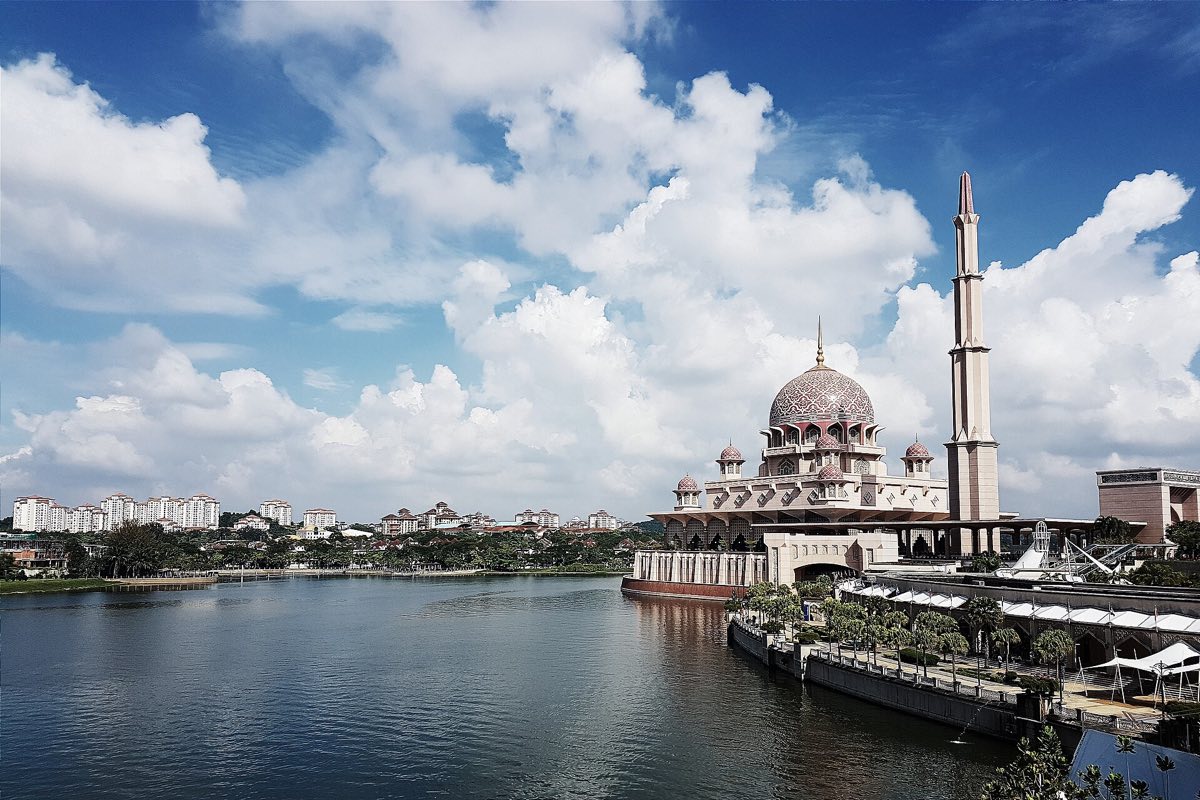
Putrajaya.
Half a day, not a full one.
A federal administrative capital designed from nothing on drained plantation land in the 1990s, with a pink mosque, a lake and some of the most photogenic bridges in Southeast Asia. It is extraordinary to look at and thin to spend a whole day in, and both of those things are true at once.
Putrajaya is a purpose-built administrative capital, laid out from scratch in the 1990s, and there is nothing else quite like it within reach of Kuala Lumpur. The Putra Mosque — the pink one, in rose-tinted granite on the lake edge — Perdana Putra above it, the bridges, the wetlands and a lake cruise are all genuinely worth seeing. What is not there is street life, because the city was designed for civil servants who drive home at 18:00. Half a day is right. A full day is not. Reachable on the KLIA Transit from KL Sentral, which makes it easy to bolt onto a morning.
A capital city built as a plan
Putrajaya is what happens when a government decides its ministries should not be in the same traffic as everybody else, and then builds them a city thirty kilometres south.
Construction started in the mid-1990s on former plantation land, with an artificial lake at the centre and the federal ministries arranged around it. The architecture is deliberate and coherent in a way almost no Asian capital manages — Islamic and Moorish forms rendered at civic scale, wide boulevards, and a set of bridges designed as monuments rather than as crossings. Photographed from the right angle it looks like a rendering that escaped.
The Putra Mosque is the centrepiece: rose-tinted granite that reads pink in almost any light, sitting on the water below Perdana Putra, the green-domed prime minister’s office. Entry is free and robes are provided; like all working mosques in Malaysia it closes to visitors during prayer times, and the published clock times are not reliable enough for us to print — ask at the desk when you arrive.
The honest weakness is the absence of everything a city normally has around its monuments. There are few small shops, almost no hawker culture, and after office hours the boulevards empty. It is the same complaint we make about TRX and KLCC at a much larger scale: excellent public space, no street life. That is precisely why half a day works and a full day does not.
There is one genuine addition beyond the photographs: the Putrajaya Wetlands, the constructed wetland system that filters the lake, which is a serious piece of environmental engineering and pleasant to walk in the early morning. Combined with a lake cruise, that fills a morning properly.
Half a day in Putrajaya
KLIA Transit from KL Sentral
Putrajaya sits on the KLIA Transit line, which is the same railway as the airport express but with intermediate stops — so this is a short, air-conditioned, entirely predictable run from KL Sentral. Once you arrive you will need Grab between the sights: Putrajaya is laid out on a driving scale and the distances between monuments are not walkable in the heat.
The Putra Mosque and Perdana Putra — free
Start here while it is still cool and the light is on the granite. The Putra Mosque is free to enter, robes are provided at the door, and it closes to visitors during prayer times — ask on arrival rather than trusting any posted schedule. Directly above it is Perdana Putra, the prime minister’s office under its green dome, and the plaza between them is the single best vantage point in the city.
The bridges and the boulevard
Seri Wawasan with its asymmetric white sail, Seri Gemilang on the ceremonial axis, and the Putra Bridge below the mosque — designed as set pieces and photographed as such. This is the outdoor half of the visit and it belongs before 11:00; there is very little shade anywhere on the boulevard and the lake reflects the heat back at you.
The lake cruise
Boats run on Putrajaya Lake and it is the best way to see how deliberately the whole thing was composed — the ministries, the bridges and the mosque all read differently from the water. It is also shaded and moving, which at 11:15 matters. Cruise operators sell traditional-boat and larger-cruiser options; both cover the same water.
The wetlands, or head back
The Putrajaya Wetlands are the constructed marsh system that cleans the lake, and they are a genuinely interesting hour if you like infrastructure with birds in it. If you do not, this is the point to go back to the station. Do not try to stretch this into a full day — there is no evening here to stay for, and Kuala Lumpur’s starts at 19:00.
Or take the sunset version instead
If the photographs are the entire point, the other way to do this is as an evening trip: the mosque and the bridges lit after dark, a sunset cruise on the lake, and back into Kuala Lumpur for a late dinner. That version competes with your KL evening, which is a real cost — see KL after dark before you trade it away.
Putrajaya from Kuala Lumpur, practically
Where to book the Putrajaya half-day
Almost every ticketed attraction in Kuala Lumpur charges foreigners more than Malaysians — Petronas is RM98 against RM35, a 180% gap. Resellers headline the MyKad rate. Every price on this site is the non-MyKad rate you will actually pay, and the gate price sits next to the reseller price so you can see the markup.
Putrajaya day trip FAQ
Is Putrajaya worth visiting from Kuala Lumpur?
As a half-day, yes. It is a purpose-built administrative capital with a pink granite mosque on a lake, monumental bridges and coherent civic architecture you will not see anywhere else in Malaysia. As a full day, no — there is very little street life and no evening to stay for.
How do I get to Putrajaya from Kuala Lumpur?
The KLIA Transit from KL Sentral, which is the same railway as the airport express with intermediate stops. Once you are there you will need Grab between the sights — Putrajaya was laid out at driving scale and the monuments are a long way apart.
Is the Putra Mosque free to enter?
Yes, and robes are provided free at the door. Like every working mosque in Malaysia it closes to visitors during prayer times. The posted hours are not consistent enough for us to publish, so ask at the desk when you arrive rather than planning to the minute.
How long do you need in Putrajaya?
Four to five hours. The mosque, Perdana Putra, the bridges and a lake cruise fill a morning comfortably; adding the wetlands takes it to about lunchtime. Beyond that you are walking around ministries, and Kuala Lumpur is a short train ride away.
Is Putrajaya better than Melaka or Ipoh?
No, and it is not really competing. Ipoh and Melaka are full-day trips to real towns with their own food cultures; Putrajaya is a half-day architectural visit close to the city. If you only have one spare day, spend it on Ipoh.
Can I combine Putrajaya with the airport?
It sits on the KLIA Transit line between KL Sentral and the airport, which makes it a plausible stop on a long layover — but only on a very long one. Read the cut-offs on our layover playbook first, because the arithmetic is tighter than it looks.
What is there to eat in Putrajaya?
Not much, honestly, and that is the most telling thing about the place. There is little hawker culture and few small shops — a planned city built for people who commute out of it. Eat before you go or eat when you get back; Kuala Lumpur is twenty minutes of train away.